A short history of Patagonia fleece
How a sweater made from toilet seat cover fabric turned into the most copied layer in outdoor clothing, why people now pay hundreds of dollars for old ones, and why so many of the best ones ended up in Japan.
A wet wool sweater
Before fleece, climbers stayed warm in wool. Yvon Chouinard’s favorite wool sweater was warm and tough, but it got heavy when it was wet, dried slowly and was a pain to clean. The idea for something better came from North Atlantic fishermen, who wore a synthetic pile sweater. Helly Hansen had developed that fabric with Norwegian Fiber Pile back in 1961.
Nobody sold anything like it in the United States, so Malinda Chouinard went looking in the Los Angeles fashion district. She came back with a polyester pile meant for toilet seat covers, and saw a sweater in it. Patagonia worked with Malden Mills, a Massachusetts textile company, to make a sturdier version, and its first pile jackets became an early best seller.
Synchilla and the Snap-T
Pile was warm but it pilled and looked rough. Malden Mills and Patagonia kept working on it and landed on a softer, double-faced polyester fleece that didn’t pill. Patagonia called it Synchilla, short for synthetic chinchilla. Accounts differ on whether the first Synchilla garments came out in 1981 or 1985, but they agree on the Snap-T: it debuted in 1985 with the yoke, the contrasting chest pocket and the mountain logo on the chest, and it quickly turned up in mountain towns and on college campuses. Patagonia added Retro Pile in 1988.
Fleece for everyone
Malden Mills sold the same kind of fabric to other brands as Polarfleece and later renamed it Polartec. Owner Aaron Feuerstein never patented it, which helped fleece spread fast and stay cheap. By the late 1980s bright fleece prints were all over European ski slopes, and within about a decade fleece had largely replaced wool and pile in outdoor clothing. Malden Mills itself became Polartec Inc. in 2007.
Meanwhile Patagonia leaned into prints. The catalog on this site starts in the late 1980s, runs through the wildest years of the 1990s, when Snap-Ts came in everything from aztec geometrics to sea creatures, and follows the prints Patagonia brought back from the 2010s on.
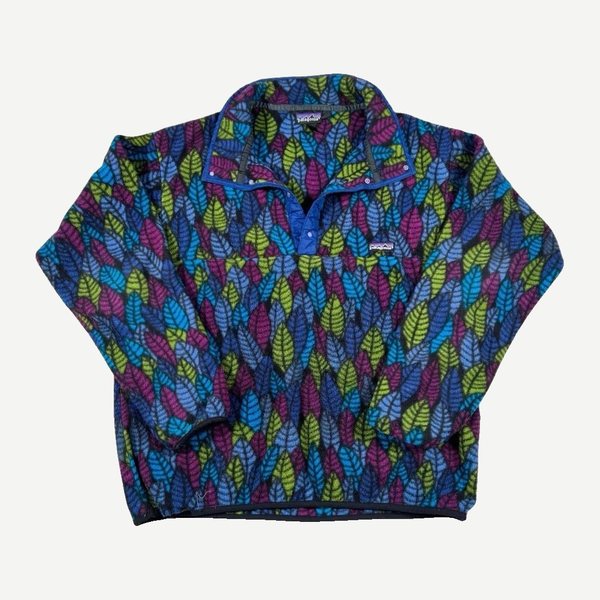
Photo: ebay.com
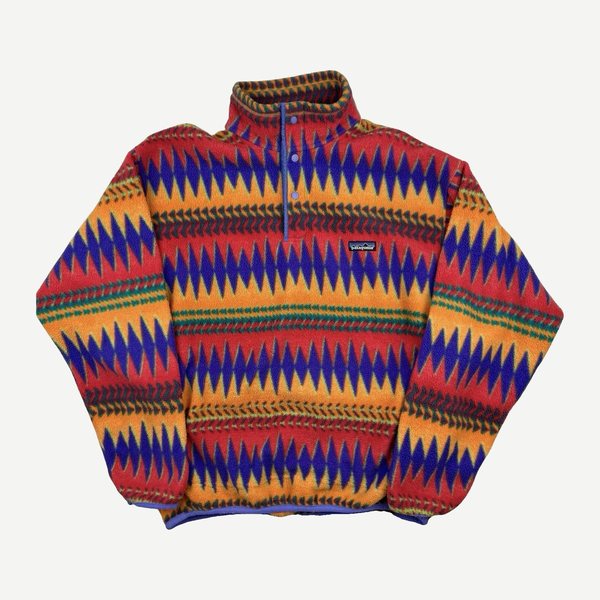
Photo: ebay.com
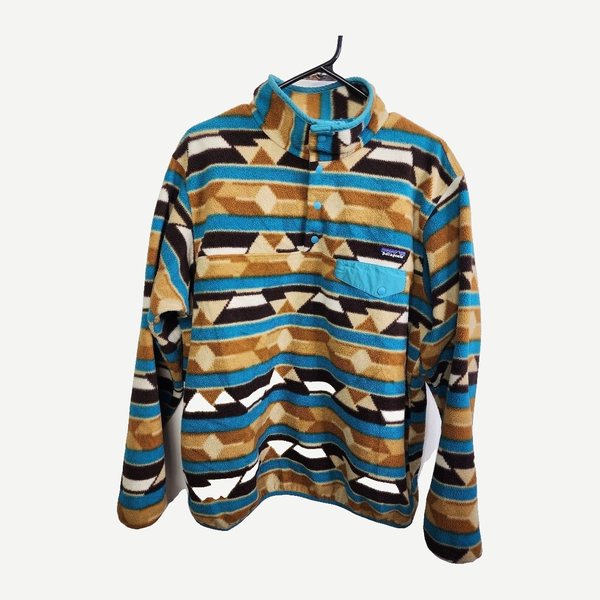
Photo: poshmark.com
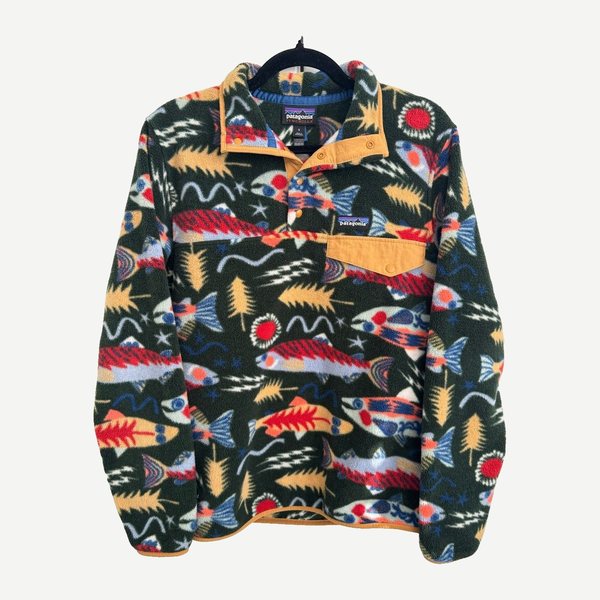
Photo: poshmark.com
Made from bottles
In 1993 Patagonia became the first outdoor company to make clothing from used plastic bottles, and from 1994 the Snap-T has been made with recycled polyester. That is a big part of why the fleece became a symbol for the brand and not just a product.
Fleece has a cost, though. In 2016 Patagonia paid researchers at the Bren School at UC Santa Barbara to measure how much synthetic jackets shed in the wash. A single garment can release thousands of tiny fibers per wash, and treatment plants catch most but not all of them. Top-loading washers shed about seven times as much as front-loaders, and a cheap generic fleece shed far more over its life than a Patagonia one. Patagonia published the results, started selling a filtering wash bag in 2017, and now tells buyers to wash synthetics less often. For an old fleece, that advice is easy to follow.
Don’t buy this jacket
On Black Friday 2011, Patagonia ran a full-page ad in The New York Times showing one of its fleece jackets under the headline “Don’t Buy This Jacket,” asking people to repair and reuse what they already owned. That idea grew into Worn Wear, Patagonia’s program for repairing, trading in and reselling used gear.
In September 2022 the Chouinard family gave the company away. All of the voting stock, about 2 percent of the total, went to the Patagonia Purpose Trust, which exists to protect the company’s values. The other 98 percent went to the Holdfast Collective, a nonprofit that receives the profits Patagonia doesn’t reinvest and spends them on the environmental crisis. Patagonia estimated that at about $100 million a year.
Why people collect them
Old Patagonia fleece has a real collector market. A Wall Street Journal story on it found two camps among people chasing pre-2000 fleece: those who care about texture, like deep pile, and those who care about bold patterns. The rarest patterns are hard to find in the United States and tend to surface on Japanese resale sites, where one Spiral fleece was listed at $970. Vintage Retro Pile jackets have sold on eBay for around $300, sometimes much more.
For printed Snap-Ts, what moves the price is fairly consistent:
- The print. Early and short-run prints are worth far more than the common ones.
- The era. A “Made in USA” tag on a printed Snap-T almost always means the 1990s, and buyers pay for it. The dating guide shows how to read the tags.
- Size and cut. Men’s sizes, especially the larger ones, are what most buyers are hunting for.
- Condition. Pilling, fading, a cracked snap or a torn pocket all take money off.
Japanese sellers on eBay regularly ask several hundred dollars for 1990s Snap-Ts in good shape. You can see what is listed right now, and for how much, on the for sale page.
Japan
Japan’s love of American outdoor clothing is older than the Snap-T. In the 1970s the Heavy Duty trend had young people in Tokyo wearing American camping and outdoor gear on the street. Popeye magazine launched in 1976 as “the magazine for city boys” and showed readers the sporty, outdoor life of the American West Coast instead of the East Coast Ivy look. By the 1980s Japanese shops were importing American vintage and deadstock, and by the 1990s those pieces were staples.
Patagonia fit right in. Kazuhiko Kai, who opened the outdoor shop Bamboo Shoots in Nakameguro in 1998, remembers that the coolest people at the clothing store he went to as a young man all wore Retro Pile cardigans, and that he had to go to the Patagonia store in Mejiro to get one. Japanese fans have long hoarded old Patagonia while Americans sent theirs to thrift stores, which helps explain why so many rare prints are in Japan today and why Japanese vintage shops often list Snap-Ts with the full style and season code off the tag.
Patagonia’s Japan office is in Kamakura, and it has leaned hard into used clothing. In 2025 the head of Patagonia Japan said he wanted secondhand to be the fastest growing part of the business there, and the new Tokyo Kyobashi store opened that year with a permanent Worn Wear corner. Japanese select shops like Beams and United Arrows also commission their own versions of Patagonia pieces, which is why some Snap-Ts only exist in Japan.
Gorpcore
In May 2017, writer Jason Chen gave the look a name in The Cut: gorpcore, a riff on normcore and on gorp, the hiker’s trail mix often said to stand for “good ol’ raisins and peanuts.” It describes clothing built for the outdoors and worn in the city, and Patagonia is one of the brands most tied to it. Japan’s outdoor style magazines had been doing the same thing for years, and much of the vintage that fuels the trend passed through Japanese shops first.
Gorpcore made fleece fashionable again, but the Snap-T never really left. It is still in the Patagonia line, still made from recycled polyester, and the old printed ones are still in closets waiting to be found. That is what this site is for.
Timeline
| Year | What happened |
|---|---|
| 1961 | Helly Hansen and Norwegian Fiber Pile make a synthetic pile sweater for seamen |
| 1970s | Malinda Chouinard finds polyester pile in Los Angeles; Patagonia makes its first pile garments with Malden Mills |
| 1976 | Popeye launches in Tokyo, bringing West Coast outdoor style to Japanese readers |
| 1985 | Synchilla Snap-T debuts |
| 1988 | Retro Pile arrives |
| 1993 | Patagonia makes fleece from recycled plastic bottles |
| 1994 | The Snap-T switches to recycled polyester |
| 2007 | Malden Mills becomes Polartec Inc. |
| 2011 | “Don’t Buy This Jacket” runs on Black Friday |
| 2016 | Patagonia publishes its microfiber shedding study |
| 2017 | “Gorpcore” is coined in The Cut |
| 2022 | The Chouinards transfer the company to a trust and a nonprofit |
| 2025 | Patagonia Tokyo Kyobashi opens with a permanent Worn Wear corner |
Sources
- The Story of Fleece, Patagonia
- Better Than Wool, Skiing History
- About Polartec, Polartec
- Polartec 40 Years, Outside
- A Brief History of Patagonia Fleeces, HHV Journal
- How fleece transformed what we wear in the outdoors, The Great Outdoors
- Polar Fleece, Encyclopedia.com
- Patagonia Snap-T 35th Anniversary, Houyhnhnm
- What Do We Know About Tiny Plastic Fibers in the Ocean?, Patagonia
- An Update on Microfiber Pollution, Patagonia
- Don’t Buy This Jacket, Black Friday and the New York Times, Patagonia
- The Secret History of “Don’t Buy This Jacket”, David Gelles
- New ownership for Patagonia, Textile Network
- Patagonia founder transfers ownership, The Washington Times
- On the Wall Street Journal’s vintage fleece story, InsideHook
- The Weird Origin Story of Your Favorite Patagonia Jacket, Blazer
- Guide to Beams’ 40th Anniversary Video, Ametora Extended
- The Magazines That Made Tokyo The Most Stylish Place On Earth, Mr Porter
- Japan’s love affair with Americana, Inquirer Plus
- Reborn Patagonia Retro-X, Kazuhiko Kai, Houyhnhnm
- Synchilla Snap-T 25450FA14 listing, Vintage Clothing Store JAM
- Patagonia, secondhand and climate change, The Japan Times
- Experiencing Field Philosophy in the City, Deep Tokyo
- Gorpcore: History of Outdoor Fashion, Metropolis
- Gorpcore, Wikipedia
- Gorpcore, Know Your Meme
Patagonia, Synchilla and Snap-T are trademarks of Patagonia, Inc. This site isn’t affiliated with Patagonia. If something here is wrong, I’d like to know.